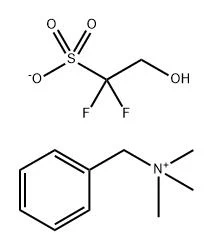
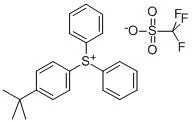
The compound is an organic salt (1:1 ratio) consisting of a quaternary ammonium cation and a fluorinated aliphatic sulfonate anion.
Cationic Component: Benzenemethanaminium, N,N,N-trimethyl- (commonly known as the benzyltrimethylammonium cation).
Anionic Component: 1,1-Difluoro-2-hydroxyethanesulfonate (a specialized difluoroalkyl sulfonate containing a terminal hydroxyl group).
Physicochemical Properties
| Property | Description / Value |
| Physical State | Crystalline solid or concentrated aqueous/organic solution (dependent on commercial purity grade). |
| Solubility | High solubility in polar organic solvents (e.g., acetonitrile, propylene glycol monomethyl ether acetate [PGMEA], dimethylformamide) and moderate-to-high solubility in water due to its ionic nature. |
| Stability | Thermally stable under standard manufacturing conditions. The fluorinated carbon-sulfur bond provides high chemical resistance against premature degradation. |
| Functional Groups | Quaternary amine (cation); aliphatic sulfonate, geminal difluoride (CF2), terminal primary alcohol (OH) (anion). |
Industrial Applications and Uses
The commercial relevance of CAS No. 1261290-18-9 resides strictly within highly specialized sectors of electronic chemical manufacturing, advanced lithography, and fine polymer synthesis.
Intermediate for Photoacid Generators (PAGs)
The primary industrial application of this compound is as a key synthetic precursor or intermediate for Photoacid Generators (PAGs) used in chemically amplified photoresists.
Advanced Photolithography: Deep ultraviolet (DUV), Extreme Ultraviolet (EUV), and electron-beam (E-beam) lithography processes rely on PAGs to change the solubility of a polymer matrix upon exposure to light.
Anion Architecture: The 1,1-difluoro-2-hydroxyethanesulfonate anion is highly valued because the terminal hydroxyl group (OH) allows for further chemical functionalization (e.g., esterification with bulky cyclic, adamantyl, or norbornane-type structures). This structural tuning controls the diffusion length of the photogenerated acid, directly improving line-width roughness (LWR), critical dimension (CD) uniformity, and exposure latitude in semiconductor wafer processing.
Phase-Transfer Catalysis and Functional Ion Exchange
Because the cation is a quaternary ammonium species (benzyltrimethylammonium), the compound can act as a surfactant-like agent or functional salt in targeted organic syntheses.
Counter-ion Exchange: It serves as a vehicle to introduce the specialized fluorinated sulfonate moiety into complex ionic matrixes, replacing less stable or more volatile fluorine-containing groups.
Regulatory and Safety Status
As a specialized industrial chemical primarily utilized in closed-system electronics manufacturing and R&D:
Regulatory Listings: The compound has been systematically reviewed and formally published under industrial safety amendments globally (for example, its name was formally published under Japan's Industrial Safety and Health Law [ISHL] in late 2019 to ensure compliant manufacturing use).
Handling Precautions: Due to the combination of a quaternary ammonium vehicle and a fluorinated sulfonate system, standard industrial hygiene protocols apply. Contact with skin and eyes should be prevented using appropriate PPE (nitrile gloves, chemical splash goggles). Thermal decomposition may release hazardous fumes, including hydrogen fluoride (HF), nitrogen oxides (NO), and sulfur oxides (SO).
Product: 1261290-18-9,BTM-DFM,Semiconductor Photoresist,Electronic Chemicals,PAG
![2758367-55-2,Thiophenium, 1-[4-(1,1-dimethylethyl)phenyl]tetrahydro-, bromide (1:1)](https://www.pudeepharm.com/wp-content/uploads/2026/05/20260525040002947046.webp)