![2758367-55-2,Thiophenium, 1-[4-(1,1-dimethylethyl)phenyl]tetrahydro-, bromide (1:1)](https://www.pudeepharm.com/wp-content/uploads/2026/05/20260525040002947046.webp)
Product Description
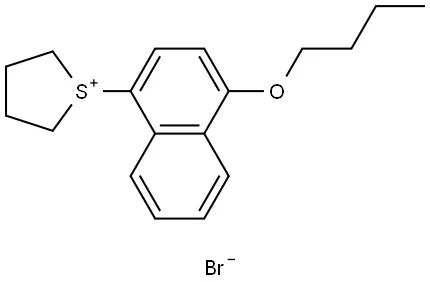
BPT-Br is a specialized organic onium salt belonging to the cyclic sulfonium family—specifically, a thiophenium derivative. Its core framework features a positively charged tetrahydrothiophene ring where the sulfur atom is directly bonded to a para-substituted tert-butylphenyl group. Balance of charge is achieved via a bromide counter-anion in a strict 1:1 stoichiometric ratio.
The inclusion of the tert-butyl (1,1-dimethylethyl) moiety significantly enhances the compound's lipophilicity and structural volume compared to un-substituted analogs. This architectural modification imparts favorable thermal stability and unique structural properties critical for modern electronic materials and chemical synthesis.
Semiconductor Photolithography (Photoacid Generators)
Cyclic sulfonium salts, particularly those based on the tetrahydrothiophenium nucleus, are widely deployed in the semiconductor industry as components of Photoacid Generators (PAGs)
Optoelectronic and Perovskite Material Engineering
In advanced material sciences, organic halide salts are heavily utilized for surface passivation and grain-boundary modification of halide perovskite solar cells and light-emitting diodes.
- Passivation Energy: The thiophenium cation (BPT) acts as a bulky organic spacer. The positive sulfur center can coordinate to uncoordinated halide sites or alleviate under-coordinated lead defects (Pb2) at the perovskite surface.
- Halide Sourcing: The bromide (Br) counter-ion acts as an effective halide dopant or surface-treating agent, healing vacancy defects in mixed-halide perovskite films to diminish non-radiative recombination pathways, thereby increasing open-circuit voltages and long-term device stability.
Polymerization Initiatives and Redox Catalysis
Thiophenium salts function efficiently as oxidants or co-initiators in specialized radical and cationic polymerization networks under mild thermal or light-induced conditions. The structural strain of the five-membered tetrahydrothiophene ring provides distinct thermodynamic driving forces during electron-transfer processes when compared to linear aliphatic sulfonium options.