Product Description
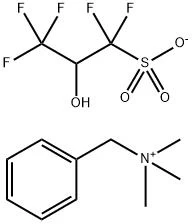
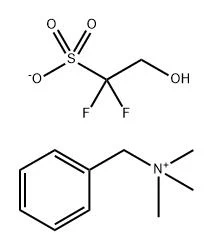
The compound is an organic salt (1:1 ratio) consisting of a quaternary ammonium cation and a fluorinated aliphatic sulfonate anion.
- Cationic Component: Benzenemethanaminium, N,N,N-trimethyl- (commonly known as the benzyltrimethylammonium cation).
- Anionic Component: 1,1-Difluoro-2-hydroxyethanesulfonate (a specialized difluoroalkyl sulfonate containing a terminal hydroxyl group).
Industrial Applications and Uses
The commercial relevance of CAS No. 1261290-18-9 resides strictly within highly specialized sectors of electronic chemical manufacturing, advanced lithography, and fine polymer synthesis.
Intermediate for Photoacid Generators (PAGs)
The primary industrial application of this compound is as a key synthetic precursor or intermediate for Photoacid Generators (PAGs) used in chemically amplified photoresists.
- Advanced Photolithography: Deep ultraviolet (DUV), Extreme Ultraviolet (EUV), and electron-beam (E-beam) lithography processes rely on PAGs to change the solubility of a polymer matrix upon exposure to light.
- Anion Architecture: The 1,1-difluoro-2-hydroxyethanesulfonate anion is highly valued because the terminal hydroxyl group (OH) allows for further chemical functionalization (e.g., esterification with bulky cyclic, adamantyl, or norbornane-type structures). This structural tuning controls the diffusion length of the photogenerated acid, directly improving line-width roughness (LWR), critical dimension (CD) uniformity, and exposure latitude in semiconductor wafer processing.
Phase-Transfer Catalysis and Functional Ion Exchange
Because the cation is a quaternary ammonium species (benzyltrimethylammonium), the compound can act as a surfactant-like agent or functional salt in targeted organic syntheses.
- Counter-ion Exchange: It serves as a vehicle to introduce the specialized fluorinated sulfonate moiety into complex ionic matrixes, replacing less stable or more volatile fluorine-containing groups.
Solubility
High solubility in polar organic solvents (e.g., acetonitrile, propylene glycol monomethyl ether acetate [PGMEA], dimethylformamide) and moderate-to-high solubility in water due to its ionic nature.
Stability
Thermally stable under standard manufacturing conditions. The fluorinated carbon-sulfur bond provides high chemical resistance
![2758367-55-2,Thiophenium, 1-[4-(1,1-dimethylethyl)phenyl]tetrahydro-, bromide (1:1)](https://www.pudeepharm.com/wp-content/uploads/2026/05/20260525040002947046.webp)