Product Description
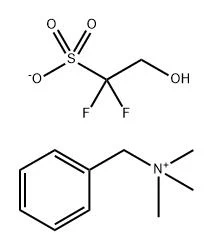
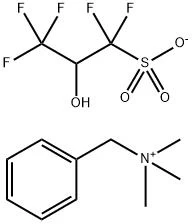
Benzenemethanaminium, N,N,N-trimethyl-, 1,1,3,3,3-pentafluoro-2-hydroxy-1-propanesulfonate (1:1), commonly known by its commercial acronym BTM-PEH or as benzyltrimethylammonium 1,1,3,3,3-pentafluoro-2-hydroxypropane-1-sulfonate, is a highly specialized organic fluorine compound. Identified by the Chemical Abstracts Service registry number CAS No. 1373617-52-7, this compound is structured as a quaternary ammonium salt paired with a highly fluorinated, functionalized alkanesulfonate anion. BTM-PEH belongs to an advanced class of industrial chemical components primarily utilized in high-performance electronic materials and advanced photolithography formulations. BTM-PEH is a classic ionic compound consisting of a distinct organic cation and a complex fluorinated anion interacting in a strict 1:1 stoichiometric ratio.
Structural Characteristics
The structural uniqueness of BTM-PEH lies in its dual-nature architectural design:
- The Cationic Domain: The benzyltrimethylammonium head group acts as a bulky, stable, and highly lipophilic organic cation. It serves to impart favorable solubility and compatibility within organic polymer matrices and photoresist solvents (such as PGMEA).
- The Anionic Domain: The 1,1,3,3,3-pentafluoro-2-hydroxy-1-propanesulfonate moiety represents a heavily fluorinated tail group containing a highly electronegative sulfonic acid group and a secondary hydroxyl (-OH) group. The presence of five fluorine atoms surrounding the carbon backbone induces a strong electron-withdrawing effect, ensuring that the conjugate acid of this anion behaves as an incredibly potent superacid once dissociated.
Primary Uses and Industrial Applications
BTM-PEH operates predominantly in the semiconductor, microelectronics, and advanced display fabrication sectors. Its engineering design makes it highly functional within chemically amplified resist (CAR) technology.
Advanced Photolithography (Photoacid Generators & Additives)
In modern semiconductor manufacturing, deep ultraviolet (DUV, 193 nm) and extreme ultraviolet (EUV, 13.5 nm) lithography rely on Photoacid Generators (PAGs) to replicate intricate sub-nanometer circuit pathways onto silicon wafers.
Acid Strength Modulator: BTM-PEH is regularly deployed as a structural precursor, counterion component, or design matrix variant for ionic photoacid generators. The pentafluoropropanesulfonate architecture ensures that the photochemically generated acid is strong enough to cleave resist polymers efficiently, while limiting unwanted volatile outgassing.
Quencher Additive: Due to the relatively basic nature of the quaternary benzyltrimethylammonium cation under specific parameters, variants of this salt category can function as photo-destroyable quenchers or diffusion controllers. This curbs the uncontrolled migration of generated acids into unexposed zones, effectively minimizing line-edge roughness (LER) and maximizing lithographic resolution.
Functional Electronic Polymers
Beyond microchips, BTM-PEH's chemical framework is highly valued in the synthesis of specialized functional electronic new materials.
- Solubility and Film Uniformity: Its dual polar/non-polar composition facilitates seamless dissolution into advanced resin matrixes, ensuring highly uniform, defect-free thin films during spin-coating application procedures.
- Ionic Liquids and Conductive Materials: As a highly stable organic fluorinated salt, its structural derivatives are explored in materials requiring tailored ionic conductivity and chemical resilience.
![2758367-55-2,Thiophenium, 1-[4-(1,1-dimethylethyl)phenyl]tetrahydro-, bromide (1:1)](https://www.pudeepharm.com/wp-content/uploads/2026/05/20260525040002947046.webp)