Product Description
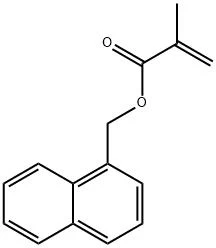
(1-Naphthyl)methyl Methacrylate is a specialized, functionalized ester derivative belonging to the methacrylate monomer family. Characterized by its naphthalene ring side chain, this compound is highly utilized within advanced macromolecular chemistry, polymer physics research, and optoelectronic development rather than large-scale commodity plastic manufacturing.The incorporation of the bulky, aromatic naphthalene moiety into the methacrylate backbone imparts distinctive physical and structural behaviors compared to traditional alkyl methacrylates.
Predicted and Measured Properties
Structural Composition: Composed of a polymerizable methacrylate head group linked via a methylene spacer to a 1-naphthyl aromatic group.
Partition Coefficient (log P): ~3.46 to 3.8 (indicating significant hydrophobicity due to the condensed aromatic rings).
Hydrogen Bond Profile: 0 Hydrogen Bond Donors; 2 Hydrogen Bond Acceptors (via the carbonyl and ester oxyvens).
Optical Signature: Strongly UV-active and inherently fluorescent owing to the naphthalene chromophore.
Core Functional Mechanisms
The industrial and scientific utility of (1-Naphthyl)methyl Methacrylate is driven by two main features:
Polymerizable Methacrylate Group: The alpha, beta-unsaturated ester group undergoes rapid radical polymerization (via thermal, UV, or redox initiation) to form homopolymers—specifically, poly(1-naphthylmethyl methacrylate)—or copolymers with other acrylic/methacrylic monomers.
Aromatic Chromophore Labeling: The naphthalene pendant group acts as a built-in fluorescent probe. This eliminates the need to post-modify polymers with external dyes, which can alter the physical behavior of the system.
Industrial and Research Applications
Because of its high synthesis/reagent cost and unique photophysical traits, (1-Naphthyl)methyl Methacrylate is deployed primarily as a high-value specialty chemical in specialized technological fields.
Polymer Physics and Latex Interdiffusion Studies
The primary application of (1-Naphthyl)methyl Methacrylate is as a fluorescent probe or molecular label to study the physical dynamics of polymer systems. It is extensively utilized to analyze the interdiffusion of polymer latex particles.
When latex films cure or fuse, polymer chains interclimb across particle boundaries. By copolymerizing minute amounts of (1-Naphthyl)methyl Methacrylate into the latex, researchers can track non-radiative energy transfer (NRET) or excimer fluorescence changes. This allows real-time measurement of chain mobility, film formation, and microscopic mixing on a nanometer scale.
Optoelectronic & High Refractive Index Polymers (HRIP)
Plastics utilizing naphthalene-containing side chains possess significantly higher refractive indices and altered optical dispersion profiles compared to standard Polymethyl Methacrylate (PMMA). Homopolymers or copolymers derived from this monomer are researched for use in:
Optical lenses and waveguiding materials.
Anti-reflective coatings for semiconductor lithography.
Light-guiding components in advanced display technology.
Photophysical and Antenna Effect Research
In macromolecular chemistry, copolymers of (1-naphthylmethyl methacrylate) are widely used to study the "antenna effect" (light-harvesting pathways in synthetic polymers). The closely packed naphthalene rings along the carbon backbone allow efficient singlet-singlet electronic energy migration. This mimics natural photosynthetic complexes by trapping absorbed photon energy and funneling it to specific luminescent acceptor sites along the chain.
Storage and Safety
Polymerization Inhibition: Due to the high reactivity of the methacrylate group, the monomer must be stabilized with a radical scavenger (such as hydroquinone or monomethyl ether hydroquinone - MEHQ).
Storage Conditions: It is typically preserved at low temperatures (often under refrigeration at 2–8°C), protected from direct light exposure to prevent auto-photopolymerization triggered by the naphthalene chromophore absorbing ambient UV light.
Regulatory Status: The compound is classified as "For Research Use Only" (RUO) across primary global chemical distribution networks and is not intended for direct human therapeutic or diagnostic applications.
![2758367-55-2,Thiophenium, 1-[4-(1,1-dimethylethyl)phenyl]tetrahydro-, bromide (1:1)](https://www.pudeepharm.com/wp-content/uploads/2026/05/20260525040002947046.webp)