Product Description
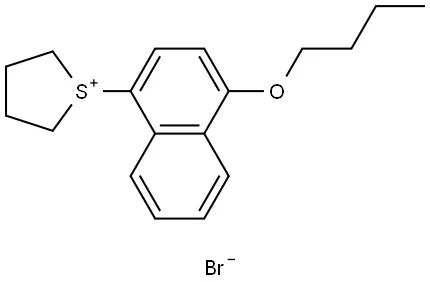
1-(4-Butoxynaphthalen-1-yl)tetrahydro-1H-thiophen-1-ium bromide (commonly abbreviated as BNT-Br) is a specialized ionic organic compound that serves primarily as an advanced functional material in microelectronics and chemical synthesis. BNT-Br belongs to the class of aryltetrahydrothiophenium salts, which are characterized by a positively charged sulfonium (thiophenium) center coordinated with a halide counterion.
Structural Components
The molecular architecture of BNT-Br consists of three primary functional segments:
The Chromophore (4-Butoxynaphthalene): A fused bicyclic aromatic ring (naphthalene) modified with an electron-donating butoxy group at the 4-position. This extended pi-electron system alters the compound's UV-vis absorption profile, shifting its sensitivity toward longer wavelengths (near-UV region).
The Onium Center (Tetrahydrothiophenium): A cyclic sulfonium group attached directly to the 1-position of the naphthalene core. The positive charge is localized on the sulfur atom within the stable five-membered saturated ring.
The Counterion (Bromide, Br): A nucleophilic halide anion that stabilizes the thiophenium cation in its crystalline ionic form.
Physicochemical Properties
Because BNT-Br is an ionic solid, its physical and chemical behaviors are distinct from neutral organic molecules:
- Appearance: Typically processed as a white to off-white crystalline powder or fine solid.
- Thermal Stability: Exhibits high thermal stability, an essential trait for components subjected to baking steps in photolithographic workflows.
- Solubility: Demonstrates selective solubility. It is typically soluble in polar organic solvents commonly utilized in polymer and industrial casting processes (such as propylene glycol monomethyl ether acetate [PGMEA], cyclohexanone, or acetonitrile), while showing minimal solubility in non-polar hydrocarbons.
- Photochemical Reactivity: The defining characteristic of BNT-Br is its sensitivity to electromagnetic radiation. Upon absorption of an appropriate wavelength of light, the carbon-sulfur (C–S) bond undergoes heterolytic or homolytic cleavage, triggering a cascade reaction that releases a strong acid.
Industrial Applications and Uses
A. Photoacid Generator (PAG) Intermediates and Systems
In industrial microelectronics, thiophenium salts are prominently utilized as Photoacid Generators (PAGs) within chemically amplified photoresist (CAR) formulations.
During photolithography, the photoresist layer is exposed to precise patterns of UV light. The BNT-Br molecule absorbs this photonic energy, causing the thiophenium ring to undergo a de-bonding mechanism. This photo-induced decomposition destabilizes the structure and ultimately releases an acid species (hydrobromic acid, HBr). The generated acid acts as a catalyst during post-exposure baking, altering the solubility of the surrounding polymer matrix to allow sub-micron circuit patterning.
While bromide salts themselves are sometimes restricted in silicon fabrication due to halide contamination risks, BNT-Br serves as a crucial compound for:
Deep UV (DUV) and Advanced Lithography Resists: Tailoring the sensitivity and absorbance of resist matrices.
Anion Exchange Intermediates: Industrial manufacturers frequently utilize BNT-Br as a structural precursor. Through metathesis (anion exchange) reactions, the bromide ion is swapped out for non-coordinating, non-volatile fluorinated anions (such as nonaflates or triflates, e.g., CAS 209482-18-8) to optimize acid diffusion lengths and lithographic resolution for sub-28nm semiconductor nodes.
B.Cationic Photoinitiators for UV Curing
The compound finds applications in specialized UV-curable coatings, inks, and adhesives. When exposed to UV radiation, the generated acid catalyzes the ring-opening polymerization of epoxides or the cross-linking of hydroxyl-functionalized resins. The 4-butoxynaphthyl group acts as a built-in photosensitizer, allowing these formulations to cure efficiently under industrial UV lamps without requiring separate sensitizing additives.
![2758367-55-2,Thiophenium, 1-[4-(1,1-dimethylethyl)phenyl]tetrahydro-, bromide (1:1)](https://www.pudeepharm.com/wp-content/uploads/2026/05/20260525040002947046.webp)