
![2773414-25-6,Thiophenium, 1-[4-(1,1-dimethylethyl)phenyl]tetrahydro-, 4-methylbenzenesulfonate (1:1)](https://www.pudeepharm.com/wp-content/uploads/2026/03/256.png)
Product Description
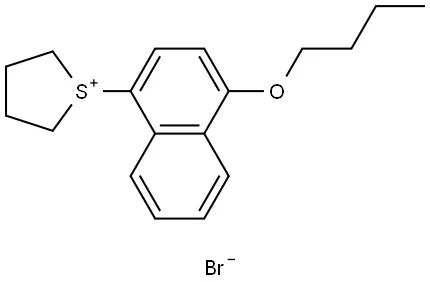
Thiophenium, 1-[4-(1,1-dimethylethyl)phenyl]tetrahydro-, 4-methylbenzenesulfonate (1:1),this compound, identified by CAS No. 2773414-25-6, belongs to the class of sulfonium salts. It is a specialized electronic chemical engineered primarily for high-performance applications within the semiconductor and microlithography sectors.
Chemical Structure and Properties
The molecule is an ionic compound (1:1 salt) consisting of a cyclic sulfonium cation and an organic sulfonate anion:
- Cation: 1-[4-(1,1-dimethylethyl)phenyl]tetrahydrothiophenium. This features a thiophene ring where the sulfur atom is saturated (tetrahydro) and carries a positive charge, bonded to a phenyl group substituted with a tert-butyl (1,1-dimethylethyl) group.
- Anion: 4-methylbenzenesulfonate (tosylate). This is the conjugate base of p-toluenesulfonic acid, which acts as the stabilizing counter-ion.
Key Characteristics:
- Thermal Stability: Designed to withstand the high-temperature cycles (soft-bake and post-exposure bake) typical of semiconductor fabrication.
- Solubility: Formulated to be highly soluble in common organic solvents used in the industry, such as Propylene Glycol Methyl Ether Acetate (PGMEA) or Ethyl Lactate.
- Radiation Sensitivity: The sulfonium center is sensitive to specific wavelengths of light (UV, DUV, or EUV) or electron beams.
Primary Industrial Application: Photoresist Industry
The compound serves as a Photoacid Generator (PAG) in Chemically Amplified Resists (CARs). This is a critical component in modern photolithography, used to pattern circuits onto silicon wafers.
Mechanism of Action
- Photolysis: Upon exposure to a specific light source (lithographic exposure), the thiophenium salt undergoes a photochemical reaction.
- Acid Generation: The decomposition of the sulfonium cation releases a strong acid (p-toluenesulfonic acid) into the surrounding polymer matrix.
- Chemical Amplification: During the post-exposure bake (PEB), the generated acid acts as a catalyst, triggering a cascade of chemical reactions (such as deprotection of the polymer resin). This changes the solubility of the resist in the developer solution.
- Patterning: Because the acid is a catalyst, a single photon can trigger many reactions, significantly increasing the "sensitivity" and speed of the lithography process.
Use in Electronic Chemicals and Semiconductors
As semiconductor nodes shrink toward 7nm, 5nm, and beyond, the requirements for PAGs become increasingly stringent. This specific thiophenium-based salt is utilized to address several technical challenges:
- Resolution and Contrast: The bulky tert-butyl phenyl group helps control the diffusion of the generated acid, preventing it from migrating too far into unexposed areas. This ensures sharp, high-resolution patterns.
- Line Edge Roughness (LER): The structural design of the tetrahydrothiophenium cation contributes to a more uniform distribution within the resist film, which is vital for reducing "noise" or roughness at the edges of the circuit lines.
- Outgassing Control: The compound is engineered to minimize the release of volatile byproducts during exposure, protecting the sensitive optics of lithography scanners (such as DUV or EUV systems).
Summary of Applications
- Semiconductor Manufacturing: Essential for deep-ultraviolet (DUV) and extreme-ultraviolet (EUV) lithography.
- Advanced Packaging: Used in the creation of micro-bumps and redistribution layers (RDL).
- Electronic Chemicals: Acts as a specialized initiator for cationic polymerization in high-purity electronic coatings.
![2758367-55-2,Thiophenium, 1-[4-(1,1-dimethylethyl)phenyl]tetrahydro-, bromide (1:1)](https://www.pudeepharm.com/wp-content/uploads/2026/05/20260525040002947046.webp)
![1242906-47-3,2-Propenoic acid, 2-methyl-, 3,5-bis[(2,2,2-trifluoroacetyl)oxy]tricyclo[3.3.1.13,7]dec-1-yl ester](https://www.pudeepharm.com/wp-content/uploads/2026/05/473.jpg)
![2376639-48-2,Ethanesulfonicacid,1,1,2,2-tetrafluoro-2-(1,1,2,2-tetrafluoro-4-tricyclo[3.3.1.13,7]dec-1-ylbutoxy)-](https://www.pudeepharm.com/wp-content/uploads/2025/12/482.jpg)