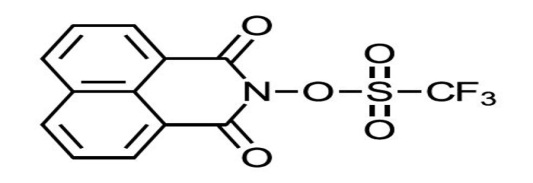
N-Hydroxynaphthalimide Triflate, commonly abbreviated as HNT or NHN-TF, is a specialty electronic chemical primarily used as a photoacid generator (PAG) in advanced photoresist formulations and microfabrication processes. The compound is valued for its ability to generate strong acid species upon ultraviolet (UV) irradiation, enabling chemically amplified lithographic reactions used in semiconductor and electronic materials manufacturing.
Chemical Identification
| Property | Description |
| Chemical Name | N-Hydroxynaphthalimide Triflate |
| CAS Number | 85342-62-7 |
| Molecular Formula | C13H6F3NO5S |
| Molecular Weight | 345.25 g/mol |
| Synonyms | HNT, NHN-TF, N-Hydroxynaphthalimide trifluoromethanesulfonate |
| IUPAC Name | (1,3-dioxobenzo[de]isoquinolin-2-yl) trifluoromethanesulfonate |
| Appearance | White to light yellow powder or crystals |
| Purity Grade | Electronic grade, typically ≥99% |
Structural and Physicochemical Properties
N-Hydroxynaphthalimide Triflate belongs to the class of nonionic photoacid generators. Structurally, it contains a naphthalimide aromatic framework combined with a trifluoromethanesulfonate (triflate) functional group. This combination provides strong UV absorption characteristics and efficient acid generation performance.
Key physicochemical properties include:
- Melting point: approximately 212–214 °C
- Solubility:
- PGMEA: approximately 1%
- γ-Butyrolactone: approximately 2%
- Ethyl lactate: less than 1%
- Density (predicted): approximately 1.76 g/cm³
- UV absorption wavelength reported near 365 nm in acetonitrile
- Light- and moisture-sensitive under ambient conditions
The compound is generally stored in sealed containers under dry and inert conditions at low temperature to preserve stability and prevent premature decomposition.
Functional Characteristics in Photoresist Systems
As a photoacid generator, HNT undergoes photochemical cleavage upon UV exposure to generate acidic species capable of catalyzing chemical transformations in photoresist polymers. This mechanism is central to chemically amplified lithography technologies used in semiconductor fabrication.
The compound is particularly important because it can:
- Induce deprotection reactions in chemically amplified resists
- Modify polymer solubility during lithographic development
- Enable high-resolution micro- and nanopattern formation
- Support controlled photochemical crosslinking and surface modification
Its nonionic nature can provide formulation advantages in certain resist systems where ionic contaminants must be minimized.
Applications in the Photoresist Industry
Semiconductor Lithography
The primary industrial application of N-Hydroxynaphthalimide Triflate is in semiconductor photoresists used for microelectronic device manufacturing. PAG materials such as HNT are incorporated into photoresist formulations for UV and deep ultraviolet (DUV) lithography processes.
In these systems, the generated acid catalyzes chemical changes that alter resist solubility, enabling precise transfer of circuit patterns onto silicon wafers. The compound is associated with advanced patterning technologies requiring high sensitivity and fine feature definition.
Electronic Chemicals and Functional Materials
HNT is also utilized in specialty electronic materials where photochemical responsiveness is required. Reported applications include:
- Patterned nanoparticle fabrication
- Photochemical surface modification
- Self-assembled monolayer (SAM) processing
- Polymer science and contact printing technologies
These applications rely on the compound’s efficient photogenerated acid chemistry and compatibility with organic material systems.
Functional Thin Films and Advanced Materials
Published supplier technical descriptions indicate that HNT has been investigated for:
- UV-irradiated cellulose-based ultrathin films
- Photo-responsive pore reopening of zeolites
- Regulation of gas permeation processes
- Volumetric manufacturing concepts for semiconductor structures
These advanced materials applications demonstrate the versatility of PAG chemistry beyond conventional lithography.
Industrial Importance
The increasing complexity of semiconductor devices has driven demand for highly efficient and electronically pure PAG materials. N-Hydroxynaphthalimide Triflate is positioned within this category due to its:
- Electronic-grade purity
- Reliable photochemical acid generation
- Thermal stability
- Compatibility with lithographic solvent systems
- Suitability for precision microfabrication
Compounds of this type are important in manufacturing integrated circuits, microelectromechanical systems (MEMS), advanced packaging materials, and other high-resolution electronic components.
Handling and Safety Considerations
Available safety information classifies the material as an irritant and combustible solid. Reported hazard statements include irritation risks to skin, eyes, and respiratory systems.
Recommended precautions include:
- Handling under dry, controlled laboratory or industrial conditions
- Avoiding prolonged exposure to moisture and light
- Using appropriate PPE such as gloves, eye protection, and respiratory protection where necessary
- Storage at 2–8 °C in sealed containers
Industrial users typically manage the compound under cleanroom-compatible electronic chemical handling protocols.
Conclusion
N-Hydroxynaphthalimide Triflate (CAS 85342-62-7) is a specialized electronic-grade photoacid generator widely associated with advanced photoresist and electronic chemical applications. Its ability to generate acid efficiently under UV irradiation makes it valuable in semiconductor lithography, nanopatterning, functional thin films, and photochemical surface engineering. With high purity requirements and precise photochemical behavior, the compound plays an important role in modern microfabrication and electronic materials technology.
Product:85342-62-7, Semiconductor Photoresist, Electronic Chemicals
![2758367-55-2,Thiophenium, 1-[4-(1,1-dimethylethyl)phenyl]tetrahydro-, bromide (1:1)](https://www.pudeepharm.com/wp-content/uploads/2026/05/20260525040002947046.webp)