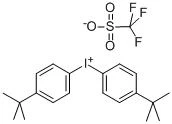
Bis(4-tert-butylphenyl)iodonium trifluoromethanesulfonate (commonly referred to as BPI-Tf or TBI-Tf) is a high-performance Photoacid Generator (PAG) widely utilized in the semiconductor and electronics industries. It plays a critical role in the formulation of chemically amplified photoresists used for advanced photolithography.
Chemical Profile and Properties
| Property | Value / Description |
| CAS Number | 84563-54-2 |
| Molecular Formula | C21H26F3IO3S |
| Appearance | White to off-white crystalline powder |
| Solubility | Highly soluble in common organic casting solvents such as PGMEA (Propylene Glycol Monomethyl Ether Acetate) and Ethyl Lactate. |
| Thermal Stability | Exhibiting high thermal stability, typically up to 140°C or higher in phenolic matrices, making it suitable for industrial baking processes. |
Chemical Structure and Functionality
The molecule consists of a diaryliodonium cation and a trifluoromethanesulfonate (triflate) anion. The tert-butyl groups on the phenyl rings enhance the compound's solubility in organic resist matrices and improve its compatibility with hydrophobic polymers. The triflate anion is a "super-acid" precursor, known for its high acid strength and moderate mobility within a polymer matrix.
Role in the Semiconductor Industry
BPI-Tf is a cornerstone of Chemically Amplified Resists (CARs). In modern semiconductor manufacturing, the resolution of circuits is achieved through photolithography, where light-sensitive chemicals (photoresists) are used to pattern silicon wafers.
- Photoacid Generation: Upon exposure to ultraviolet (UV) radiation (specifically Deep-UV wavelengths like KrF 248 nm), the iodonium salt undergoes photolysis, releasing trifluoromethanesulfonic acid (CF3SO3H).
- Chemical Amplification: A single photon triggers the release of an acid molecule, which then acts as a catalyst for hundreds of subsequent deprotection reactions in the resist polymer during the Post-Exposure Bake (PEB) phase. This mechanism significantly increases the "photosensitivity" or speed of the lithographic process.
Key Industrial Applications
- Photolithography (Microchips)
It is primarily used as a PAG in deep-UV resists for the production of integrated circuits (ICs). Its stability ensures that the resist does not degrade during storage or pre-exposure handling, while its high quantum yield ensures sharp, high-resolution patterning.
- Electronic Chemicals
As a high-purity electronic chemical, it is used in the synthesis of polymers and coatings that require precise acid-catalyzed curing. Its non-metallic nature (cationic iodonium) prevents metal ion contamination, which is vital for maintaining the electrical integrity of semiconductor devices.
- Cationic Polymerization
Beyond photoresists, diaryliodonium salts are effective initiators for the cationic polymerization of epoxides and vinyl ethers under UV light. This makes them valuable in high-speed UV-curable inks, adhesives, and protective coatings for electronic components.
Safety and Handling
Bis(4-tert-butylphenyl)iodonium trifluoromethanesulfonate is generally stable under ambient conditions but is sensitive to light. It should be stored in a cool, dry place, protected from light exposure to prevent premature decomposition. Like many hypervalent iodine compounds, it is an irritant, and standard laboratory/industrial PPE (gloves, goggles) is required during handling.
Product:84563-54-2, Semiconductor Photoresist, Electronic Chemicals, BPI-Tf,PAG