Product Description
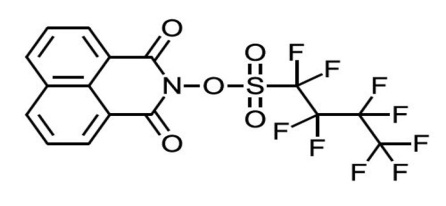
Naphthalimidyltrifluoromethane sulfonate (CAS No. 171417-91-7) is a specialty electronic chemical primarily associated with advanced photoresist and semiconductor lithography technologies. The compound belongs to the class of photoacid generators (PAGs), which are essential functional materials used in chemically amplified photoresist systems for microelectronics fabrication. Industry references also describe related materials under names such as N-Hydroxynaphthalimide triflate or Naphthalimide triflate derivatives.
Chemical Identity and Molecular Characteristics
The compound is characterized by a naphthalimide aromatic framework combined with a trifluoromethanesulfonate (triflate) functional group. Triflate-containing compounds are widely valued in electronic materials because of their strong acid-generating capability under photochemical activation.
- Molecular formula: C13H6F3NO5S
- Molecular weight: 345.25 g/mol
- Appearance: white to pale-yellow crystalline powder
- Melting point: approximately 212–214 °C
- Electronic-grade purity: typically ≥99.5%
The compound exhibits limited solubility in common lithography solvents such as PGMEA and ethyl lactate, which is consistent with its use in highly engineered photoresist formulations.
Functional Role in Photoresist Technology
Photoacid Generator (PAG)
The primary industrial function of this compound is as a photoacid generator. Upon ultraviolet (UV) or deep ultraviolet (DUV) irradiation, the material undergoes photochemical cleavage and releases a strong acid species. This acid catalyzes deprotection or solubility-switching reactions within chemically amplified resists.
This mechanism is fundamental to modern semiconductor lithography because it enables:
- High-resolution pattern transfer
- Improved photosensitivity
- Reduced exposure energy requirements
- Fine critical dimension (CD) control
- Compatibility with advanced lithographic wavelengths
Naphthalimide-based PAGs are particularly attractive because aromatic imide structures often exhibit favorable thermal stability and photochemical efficiency.
Semiconductor Industry Applications
- Chemically Amplified Photoresists
The compound is primarily used in chemically amplified resist (CAR) systems employed in semiconductor wafer fabrication. In these formulations, the PAG generates acid during exposure, triggering selective solubility changes during post-exposure bake and development.
Applications include:
- Integrated circuit fabrication
- Advanced packaging lithography
- MEMS patterning
- Thin-film transistor manufacturing
- Microelectronic device structuring
The material is associated with DUV and related lithographic processes used for high-density semiconductor manufacturing.
- Nanopatterning and Advanced Lithography
Published technical descriptions indicate that naphthalimide triflate PAGs can support patterned nanoparticle formation and volumetric microfabrication processes. These properties are relevant to emerging nanoscale manufacturing technologies.
Potential application areas include:
- Nanostructured electronic materials
- High-aspect-ratio lithography
- Micro-optical device fabrication
- Advanced resist research
- Functional Polymer Modification
The compound may also participate in acid-mediated polymer transformations, allowing controlled modification of polymer solubility and crosslinking behavior. This functionality is important in:
- Photopatternable coatings
- Dielectric materials
- Specialty electronic films
- Surface modification systems
Performance Advantages
Naphthalimide triflate-based PAG systems are valued for several technical characteristics:
- High thermal stability
- Efficient acid generation under UV exposure
- Low volatility during processing
- Compatibility with electronic-grade formulations
- Suitability for precision microfabrication
These properties support stable lithographic processing and reduced defect generation in semiconductor production environments.
Electronic Chemical Manufacturing Considerations
Because the compound is used in semiconductor applications, production typically requires:
- High-purity synthesis routes
- Strict metal-ion contamination control
- Moisture-controlled handling
- Electronic-grade purification processes
- High-performance analytical characterization
Impurity management is especially critical because trace contaminants can negatively affect lithographic resolution and semiconductor device yield.
Industrial Significance
Photoacid generators such as naphthalimidyltrifluoromethane sulfonate are critical enabling materials for modern semiconductor lithography. Their ability to generate acid with high photochemical precision directly supports the fabrication of increasingly miniaturized and complex electronic devices.
As semiconductor geometries continue to shrink and lithographic precision requirements increase, high-performance PAG materials remain strategically important.
![1242906-47-3,2-Propenoic acid, 2-methyl-, 3,5-bis[(2,2,2-trifluoroacetyl)oxy]tricyclo[3.3.1.13,7]dec-1-yl ester](https://www.pudeepharm.com/wp-content/uploads/2026/05/473.jpg)
![2376639-48-2,Ethanesulfonicacid,1,1,2,2-tetrafluoro-2-(1,1,2,2-tetrafluoro-4-tricyclo[3.3.1.13,7]dec-1-ylbutoxy)-](https://www.pudeepharm.com/wp-content/uploads/2025/12/482.jpg)
![1383380-44-6,[1]Benzothieno[3,2-b][1]benzothiophene, 3,8-dibromo-](https://www.pudeepharm.com/wp-content/uploads/2025/12/446.jpg)
![1135824-87-1,2-Propenoicacid,2-methyl-,2-[(hexahydro-2,2-dioxido-3,5-methanocyclopent[d]-1,2-oxathiol-6-yl)oxy]-2-oxoethyl ester](https://www.pudeepharm.com/wp-content/uploads/2025/12/871.png)