
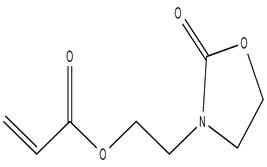
Product Description
The compound 2-Propenoic acid, 2-(2-oxo-3-oxazolidinyl)ethyl ester (CAS No. 115965-75-8), commonly referred to in the specialty chemicals industry as OXE Acrylate or 3-(2-Acryloyloxyethyl)-2-oxazolidinone, is a high-performance functional monomer. It is characterized by the presence of both a reactive acrylate group and a heterocyclic oxazolidinone ring, making it a vital component in the formulation of advanced electronic chemicals, particularly within the semiconductor and photoresist industries.
Chemical Profile and Properties
| Property | Description |
| IUPAC Name | 2-(2-oxo-1,3-oxazolidin-3-yl)ethyl prop-2-enoate |
| Molecular Formula | C8H11NO4 |
| Molecular Weight | 185.18 g/mol |
| Physical State | Typically a clear, colorless to pale yellow liquid or low-melting solid. |
| Functional Groups | Acrylate (polymerizable moiety) and 2-Oxazolidinone (polar heterocyclic moiety). |
Key Physical Characteristics:
- High Polarity: The oxazolidinone ring imparts significant polarity to the molecule, which enhances its solubility in typical photoresist solvents like Propylene Glycol Methyl Ether Acetate (PGMEA) and Ethyl Lactate.
- Adhesion Promotion: The nitrogen and oxygen atoms within the heterocyclic ring provide strong coordination sites, facilitating excellent adhesion to inorganic substrates like silicon wafers, glass, and metals.
- Thermal Stability: Compared to simple alkyl acrylates, the oxazolidinone structure provides higher thermal resistance, which is critical for the "soft bake" and "post-exposure bake" (PEB) cycles in semiconductor manufacturing.
Industrial Applications
This compound is specifically engineered for use in Electronic Chemicals, where high purity and specific reactive properties are non-negotiable.
- Photoresist Formulations
In the semiconductor industry, this compound serves as a functional monomer or reactive diluent in photoresists. Its role is multifaceted:
- Pattern Resolution: It helps control the dissolution rate of the photoresist during the development process, contributing to sharper image contrast and sub-micron resolution.
- Etch Resistance: The cyclic structure of the oxazolidinone helps improve the plasma etch resistance of the resulting polymer film, protecting the underlying circuit patterns during the etching phase.
UV-Curable Coatings and Inks
Beyond photolithography, it is used in UV-curing systems for electronics:
- Solder Masks: It provides the necessary chemical resistance and electrical insulation properties required for permanent solder masks on printed circuit boards (PCBs).
- Display Technology: It is utilized in the production of color filters and black matrix resins for LCD and OLED displays due to its high transparency and refractive index control.
Role in the Semiconductor Supply Chain
The compound is categorized as a Specialty Electronic Chemical. Its importance has grown with the transition to smaller process nodes (e.g., 7nm, 5nm, and below), where traditional monomers often fail to meet the rigorous demands of adhesion and thermal stability.
Technical Advantages:
- Low Shrinkage: The presence of the oxazolidinone ring helps reduce the volume shrinkage typically associated with the polymerization of pure acrylates, ensuring the dimensional stability of micro-patterns.
- Compatibility: It shows excellent synergy with common photoacid generators (PAGs) and other resin components in chemically amplified resists (CARs).
Safety and Handling
As an acrylate-based chemical, 2-(2-oxo-3-oxazolidinyl)ethyl ester should be handled with standard industrial hygiene practices:
- Sensitization: Like many acrylates, it may cause skin sensitization or allergic reactions upon contact.
- Storage: It should be stored in a cool, dark place, typically with a polymerization inhibitor (such as MEHQ) to prevent spontaneous polymerization.
- Environment: While specifically used in closed-loop industrial processes, it should be disposed of as hazardous chemical waste in accordance with local environmental regulations.
Summary
2-Propenoic acid, 2-(2-oxo-3-oxazolidinyl)ethyl ester is a cornerstone of modern photolithography. By bridging the gap between organic polymer chemistry and inorganic semiconductor substrates, it enables the high-precision patterning required for the next generation of integrated circuits and electronic devices.
![2376639-48-2,Ethanesulfonicacid,1,1,2,2-tetrafluoro-2-(1,1,2,2-tetrafluoro-4-tricyclo[3.3.1.13,7]dec-1-ylbutoxy)-](https://www.pudeepharm.com/wp-content/uploads/2025/12/482.jpg)
![1383380-44-6,[1]Benzothieno[3,2-b][1]benzothiophene, 3,8-dibromo-](https://www.pudeepharm.com/wp-content/uploads/2025/12/446.jpg)
![1005454-09-0,2-methyl-2-propenoic acid [3-[[1,2,2,3,3,4,4,5,5,6-decafluoro-6-(hydroxymethyl)cyclohexyl]methoxy]-1-adamantyl] ester](https://www.pudeepharm.com/wp-content/uploads/2025/04/090.jpg)