
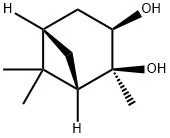
Product Description
(1S,2S,3R,5S)-(+)-Pinanediol (commonly abbreviated as (+)-pinanediol) is a high-purity, bicyclic monoterpene diol that serves as a cornerstone reagent in asymmetric organic synthesis and fine chemical manufacturing. Possessing a highly rigid, chiral bicyclo[3.1.1]heptane framework, this compound is primarily utilized as a chiral auxiliary and an intermediate in the synthesis of enantiomerically pure pharmaceuticals, complex organoboranes, and agrochemicals. (+)-Pinanediol is derived from pinene—a major component naturally found in pine resin—and features two vicinal hydroxyl groups. Its unique structural architecture imparts significant steric hindrance, which is a critical feature for establishing stereocontrol in catalytic and asymmetric synthesis.
Appearance : White crystalline powder
Assay(GC) : > 99.5%
Chiral Purity(GC): > 99.5%
Melting Point: 59–60 °C
Chemical Structure and Stereochemistry
The precise IUPAC stereochemical designation (1S,2S,3R,5S) indicates that the compound contains four asymmetric carbon stereocenters. The rigidity of the bridged bicyclic structure prevents conformational flipping. Consequently, when (+)-pinanediol coordinates or reacts with target functional groups (such as boronic acids), it selectively blocks one face of the molecule, forcing incoming reactants to approach from the less hindered face. This leads to near-absolute diastereoselectivity.
Industrial and Synthetic Applications
The industrial relevance of (+)-pinanediol stems almost entirely from its role as an optimized chiral auxiliary.
Asymmetric Organoborane Synthesis (Matteson Asymmetric Homologation)
One of the most prominent industrial applications of (+)-pinanediol is in the preparation of chiral α-chloroboronic esters. These esters serve as foundational intermediates in the production of elite therapeutics, such as proteasome inhibitors (e.g., Bortezomib). The pinanediol ester undergoes a highly stereospecific Matteson homologation reaction, enabling the insertion of carbon chains with precise stereocontrol.
Synthesis of Homochiral α-Hydroxyketones
(+)-Pinanediol is deployed as a chiral directing group or substrate for selective oxidations. For example, it is used in the specialized synthesis of optically active α-hydroxyketones via selective dioxirane oxidation methods, ensuring high chemical yields without racemization.
Resolution and Chiral Derivatization
In analytical chemistry and pharmaceutical development, (+)-pinanediol is used for:
Resolution of Boronate Esters: It is widely used to resolve complex mixtures, such as prolineboronate esters intended for enzyme-inhibition studies.
Chiral Derivatization: Acting as a derivatizing agent to determine the enantiomeric purity of unknown chiral mixtures.
Emerging Biological and Medical Research
Beyond its primary role as a synthetic building block, contemporary research is exploring the direct biological properties of (+)-pinanediol:
Cell Differentiation Induction: Studies have indicated that (+)-pinanediol induces differentiation in specific cell lines, notably S91 melanoma and PC12 pheochromocytoma cells. This differentiation capability makes it an asset in pigment cell biology and oncological proliferation research.
Melanogenesis and Nitric Oxide Production: The compound has been shown to induce melanin biosynthesis and nitric oxide pathways, presenting potential pipelines for cosmetic sunless tanning formulations or dermatological therapies.
Fibroblast Activation: It has demonstrated utility in activating fibroblasts, suggesting secondary downstream capabilities in promoting cell growth and tissue engineering research.
Handling, Safety, and Storage
According to global safety standards (GHS) and industrial manufacturing datasets:
Classification: Regulated under Storage Class 11 (Combustible Solids). It is generally classified under WGK 3 (highly hazardous to water in bulk quantities, requiring strict disposal protocols).
Personal Protective Equipment (PPE): Standard industrial handling requires the deployment of safety eyeshields, protective gloves, and a NIOSH-approved type N95 (US) or particle filter respirator to mitigate dust inhalation risks.
Storage Conditions: Keep in a tightly sealed container stored in a cool, dry, and well-ventilated space away from open ignition sources.
![230299-05-5,Bis[(+)-pinanediolato]diboron](https://www.pudeepharm.com/wp-content/uploads/2021/03/230299-05-5.jpg)