
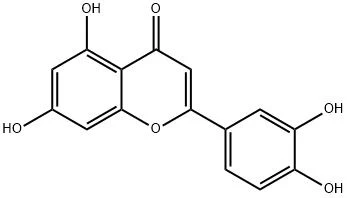
Product Description
Luteolin is a naturally occurring polyphenol belonging to the flavone subclass of flavonoids. It is widely distributed across the plant kingdom, heavily concentrated in edible vegetables, fruits, and medicinal herbs such as celery, green pepper, chamomile tea, and Lonicera japonica .Luteolin's pharmacological utility centers around its high capacity to donate hydrogen electrons via its B-ring catechol structure (C3'-OH and C4'-OH), which efficiently neutralizes reactive oxygen species (ROS) and stabilizes free radicals .
Luteolin mitigates oxidative damage to cellular DNA, lipids, and proteins. It achieves anti-inflammatory efficacy by downregulating key cellular pathways, including the Mitogen-Activated Protein Kinase (MAPK) and Nuclear Factor kappa-B (NF-κB) pathways . Furthermore, it directly inhibits ROS-generating and pro-inflammatory enzymes like xanthine oxidase, cyclooxygenases (COX), and lipoxygenases (LOX) .
In molecular docking and in vitro assays, luteolin acts as a competitive inhibitor against specialized bacterial and viral structures. For instance, it binds to the active sites of sortase A (SrtA) in pathogens like Listeria monocytogenes, suppressing transpeptidase activity and preventing cell invasion. In virology research, it has demonstrated an affinity for blocking critical entry mechanisms, such as the angiotensin-converting enzyme 2 (ACE2) receptor complex and viral proteases (e.g., 3CLpro) associated with respiratory viruses.
Cardiovascular and Neuroprotective Applications
Preclinical models show that luteolin protects endothelial barriers and reduces myocardial ischemia-reperfusion injury through pathways like FOXP1-NLRP3 . Its ability to modulate neuroinflammation gives it utility in therapeutic research regarding neurodegenerative conditions, including Alzheimer's and Parkinson's diseases.
Industrial & Commercial Applications
Despite its potent bioactivity, luteolin possesses poor lipophilicity and hydrophilicity, resulting in low oral bioavailability. Modern industrial practices address this by utilizing solid dispersions, co-crystallization, and structural modifications to widen its commercial applications across multiple sectors.
Pharmaceutical & Nutraceutical Formulation
Bioavailability Enhancements: Industrially, luteolin is formulated into solid dispersions using carrier polymers like Polyethylene Glycol (PEG 4000) through melting or solvent evaporation methods, boosting its dissolution rate past 90% .
Structural Derivatives: Chemical manufacturing focuses on synthesizing acyl, alkyl, and salt derivatives targeting the phenolic hydroxyl positions to yield more stable, bioavailable prodrugs for dermatological or systemic treatments (e.g., managing psoriasis).
Agro-Food and Functional Dairy Production
Protein-Polyphenol Complexes: In the functional food industry, luteolin is integrated into dairy matrices. By binding non-covalently with milk proteins (such as casein) via hydrogen bonding and hydrophobic interactions, processing facilities successfully bypass its natural environmental instability. This increases the overall oxidative stability, gel structure, and shelf-life of fermented dairy products.
Natural Preservatives: Due to its antimicrobial profile, it serves as an additive to prevent lipid peroxidation in high-fat food matrices.
Cosmetics & Oral Care Products
Anti-Aging Topicals: Luteolin's skin-barrier protective properties and capacity to limit UV-induced oxidative cascades make it a highly sought-after active ingredient in anti-aging creams and sun-care cosmetics.
Periodontal Therapeutics: Because it reduces localized alveolar bone destruction and subdues gingival inflammation, luteolin is increasingly integrated into medical-grade toothpastes and oral rinses designed to treat periodontal diseases.