
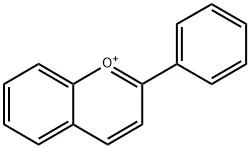
Product Description
Flavylium (specifically the flavylium cation, structurally identified as 2-phenyl-1-benzopyrylium or 2-phenylchromenylium) is a positively charged, oxygen-containing heterocyclic aromatic compound. It serves as the foundational core skeleton for a major class of water-soluble plant pigments known collectively as flavonoids, which prominently include anthocyanidins and anthocyanins. The physical and chemical behavior of flavylium-based compounds is fundamentally defined by a pH-dependent reversible multi-equilibrium network. The flavylium cation itself is only thermodynamically stable and dominant under highly acidic conditions.
When the pH of a flavylium solution is altered, it undergoes four primary structural interconversions (acid-base, hydration, tautomerization, and isomerization) to yield a complex multistate of distinct molecules.Due to this structural network, increasing the pH typically leads to color bleaching as the vibrant flavylium cation transitions into uncolored hemiketal and chalcone species, unless stabilized by copigmentation or complexation.
Industrial and Research Applications
While the unsubstituted core flavylium salt is primarily utilized as a benchmark reference in scientific research, its diverse natural and bioinspired synthetic derivatives hold significant commercial and industrial value.
- Food and Beverage Industry (Natural Colorants)
Natural derivatives of the flavylium cation (anthocyanins) represent the primary class of water-soluble pigments responsible for the brilliant red, purple, and blue colors found in fruits, vegetables, and flowers. Industrially, these compounds are extracted or chemically/enzymatically synthesized to replace synthetic azo-dyes as clean-label, non-toxic natural colorants.
- Smart Materials and Photochromic Systems
Because the transition between the trans-chalcone (C) and the flavylium cation (AH) can be driven by light, synthetic flavylium systems function as advanced photochromic materials. Irradiation of the chalcone form triggers a photochemical pathway that reconstructs the colored flavylium/quinoidal species. This has profound applications in:
- Optical memory storage systems
- Light-responsive molecular switches
- Smart windows and light-sensitive optical displays
- Solar Energy Harvesting (Dye-Sensitized Solar Cells)
The extended pi-conjugated benzopyrylium network affords flavylium compounds broad light-absorption profiles stretching across the visible spectrum (lambdamax\sim 450–650nm). This property has led to extensive application as metal-free, eco-friendly photosensitizers in Dye-Sensitized Solar Cells (DSSCs), acting as organic alternatives to expensive ruthenium-based complexes.
- Biomedical and Pharmaceutical Applications
Synthetic and natural flavylium derivatives display a broad spectrum of verified biological activities. Owing to their structural capability to neutralize free radicals, these polyphenolic architectures are widely utilized in functional health supplements and therapeutics for their (Pure – U NOVA):
- Antioxidant and anti-inflammatory properties
- Antimicrobial and antiproliferative (anti-cancer) activities
- Potential to mitigate cardiovascular and metabolic disorders