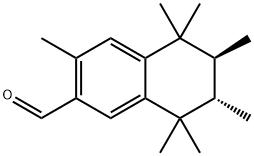
The compound (CAS No. 167254-80-0) is a highly substituted polycyclic aldehyde belonging to the tetrahydronaphthalene fragrance compound family. Structurally, it contains a rigid hydrophobic bicyclic framework combined with an aldehyde functional group, a feature commonly associated with high-impact fragrance molecules and substantive odor performance in perfumery applications.
Properties
| Property | Value |
| Molecular Formula | C₁₈H₂₆O |
| Molecular Weight | 258.40 g/mol |
| Chemical Class | Polycyclic aldehyde |
| Functional Group | Aldehyde |
Publicly available open-source data regarding melting point, boiling point, odor threshold, refractive index, and vapor pressure for this substance remain limited. No authoritative IFRA or FEMA sensory monograph was identified in the available sources at the time of writing.
Fragrance and Olfactory Profile
Based on its molecular architecture and classification as a perfumery aldehyde intermediate, the material is understood to function as a specialty fragrance ingredient intended for fine fragrance and functional fragrance compositions. However, verified public-domain odor descriptors for this exact CAS number are scarce, and unsupported sensory claims should therefore be avoided.
Polycyclic aldehydes of this type are generally valued in perfumery because they may contribute:
- High substantivity
- Excellent diffusion characteristics
- Stability in complex formulations
- Long-lasting performance on substrates
Because stereochemistry significantly affects odor behavior in fragrance chemistry, the defined chiral configuration ((6S,7S)) is likely important to its olfactory profile and commercial value.
Industrial Uses
- Fine Fragrance Formulation
The compound is used as a specialty aroma chemical in premium perfume accords where long-lasting and structurally complex odor profiles are desired.
Possible formulation roles include:
- Modifier material
- Fixative-support ingredient
- Character-enhancing aldehydic note
- Woody/amber structural component
- Functional Fragrances
Compounds of this class may also be incorporated into:
- Fabric care fragrances
- Air fresheners
- Household cleaners
- Personal care products
- Soap and detergent fragrance systems
Its polycyclic structure suggests relatively good chemical stability compared with more volatile low-molecular-weight aroma materials.
- Aroma Chemical Research and Development
Due to its stereochemically defined structure, the material is relevant in:
- Chiral fragrance chemistry
- Structure–odor relationship studies
- Synthetic aroma chemical development
- High-performance fragrance ingredient screening
Manufacturing and Synthetic Importance
The compound represents a specialized synthetic fragrance intermediate rather than a naturally occurring essential oil constituent. Production generally involves:
- Multi-step organic synthesis
- Controlled stereochemical synthesis
- Selective aldehyde functionalization
Chiral purity is often commercially important in advanced perfumery materials because different stereoisomers may exhibit substantially different odor properties.
Safety and Regulatory Considerations
No comprehensive publicly accessible toxicological dossier or globally harmonized classification specific to CAS 167254-80-0 was identified in the consulted open references. Industrial users should therefore rely on:
- Supplier-issued SDS documentation
- IFRA guidance where applicable
- Internal toxicological assessment
- Regional chemical regulatory compliance requirements
As with many aldehydic fragrance materials, standard industrial handling precautions are recommended:
- Avoid direct inhalation
- Prevent prolonged skin exposure
- Use appropriate ventilation
- Store in tightly sealed containers away from oxidation sources
Conclusion
The compound (CAS No. 167254-80-0) is a specialized chiral polycyclic aldehyde fragrance ingredient used primarily in advanced perfumery and aroma chemical applications. Its rigid tetrahydronaphthalene framework and aldehyde functionality make it structurally suitable for high-performance fragrance systems requiring substantivity, stability, and diffusion.
Although publicly available technical and olfactory data remain limited, the compound is recognized within the fragrance chemistry field as a sophisticated synthetic aroma material with potential applications in fine fragrance, functional fragrances, and aroma research.
Product:167254-80-0,Vulcanolide,Fragrance,Perfume ingredient