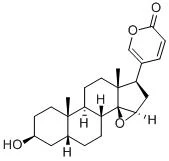
Resibufogenin (also referred to as bufogenin or recibufogenin) is a highly bioactive, naturally occurring steroid compound belonging to the class of bufadienolides. It serves as one of the primary active markers isolated from the skin and parotoid venom glands of Asiatic toads, such as Bufo gargarizans or Bufo melanostictus. This secretion is traditionally processed into the oriental crude drug known as Chansu (toad venom). Due to its potent cardiotonic and emerging oncological profiles, resibufogenin has transitioned from traditional applications into a focus of modern biopharmaceutical research and fine chemical manufacturing.
Chemical and Physical Properties
Resibufogenin is chemically classified as a C-24 cardiotonic steroid derivative. It is structurally characterized by a tetracyclic core combined with a specific 6-membered alpha-pyrone (lactone) ring at the C-17 position and an epoxide group bridging the C-14 and C-15 positions.
Physical Appearance: White to off-white crystalline powder
Solubility: Lipophilic nature; highly soluble in organic solvents (e.g., methanol, DMSO, chloroform) but exhibits poor aqueous solubility.
Pharmaceutical and Medicinal Uses
Resibufogenin displays a broad spectrum of verified pharmacological applications, heavily evaluated across modern pre-clinical settings:
Oncology (Antitumor Activity)
Resibufogenin has demonstrated significant in vitro and in vivo efficacy across various malignancies, including hepatocellular carcinoma, lung adenocarcinoma, pancreatic cancer, colorectal cancer, ovarian cancer, and glioblastoma.
- Cell Cycle Arrest: It induces G2M phase cell cycle arrest and blocks proliferation pathways in tumor cells.
- Apoptosis Induction: It triggers programmed cell death via mitochondrial pathways, modulating Bcl-2family expressions and activating caspase-3 cascades.
- Senolytic Action: Recent screening methodologies have identified resibufogenin as an active senolytic agent capable of selectively clearing senescent cells via caspase-dependent apoptosis.
Cardiovascular Modulation
Historically used as a cardiotonic stimulant, the compound increases myocardial contractility. This action must be strictly managed due to its low therapeutic index, where narrow dosage margins separate beneficial cardiac stimulation from serious cardiotoxicity.
Analgesic and Anti-Inflammatory Effects
Resibufogenin is widely utilized as a topical anesthetic and localized analgesic It actively mitigates acute and chronic inflammatory symptoms by reducing systemic inflammatory cytokine cascades.
Industrial and Advanced Formulation Applications
Because raw resibufogenin suffers from poor water solubility, a low therapeutic index, and distinct mucosal irritation, its industrial applications center heavily on advanced chemical delivery formulations.
High-End Excipient & Complex Manufacturing
To circumvent its poor dissolution rate and mitigate gastric mucosa irritation, chemical manufacturers utilize co-evaporation techniques to create inclusion complexes. For instance, reacting resibufogenin with beta-cyclodextrin (beta-CD) or 2-hydroxypropyl-beta-cyclodextrin (HP-beta-CD) at a 1:2 molar ratio dramatically increases its aqueous dissolution speed while retaining full biological potency.
Biodegradable Nanoparticle Synthesis
In advanced nanobiotechnology sectors, resibufogenin is processed into polymeric matrices to achieve targeted, sustained release. A primary industrial deployment involves encapsulating the compound into poly(lactic-co-glycolic acid)-d-alpha-tocopheryl polyethylene glycol 1000 succinate (PLGA-TPGS) nanoparticles. This polymer configuration yields:
- Optimized drug loading and encapsulation efficiency.
- Mitigated cardiotoxicity by preventing immediate systemic accumulation.
- Enhanced targeting capabilities toward specific lesion sites like liver tissue.
Toxicology and Safety Considerations
Resibufogenin is classified as a highly potent toxin. Industrial handling requires stringent engineering controls (glove boxes, local exhaust ventilation) and appropriate personal protective equipment (PPE).
- Local Irritation: The raw compound induces severe irritation when exposed to mucosal membranes or gastrointestinal linings.
- Systemic Toxicity: Unbiased or excessive systemic absorption triggers severe cardiotoxicity (via excessive potassium rectifier current distortion and cellular Na+K+-ATPase shutdown) and acute neurotoxicity (excitotoxicity resulting in cell death).
Product:465-39-4,Resibufogenin