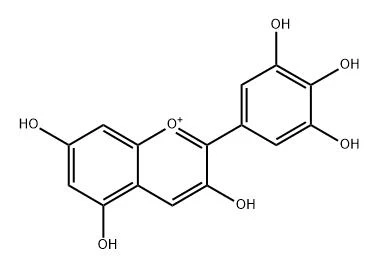
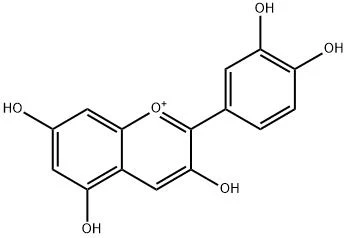
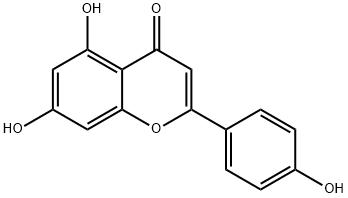
Delphinidin is a prominent organic compound belonging to the anthocyanidin family, a major subgroup of flavonoids. Structurally, it serves as the aglycone (sugar-free core) of various anthocyanin pigments responsible for the deep blue, purple, and red hues observed in diverse flora, such as blueberries, grapes, pomegranates, and violas.
Delphinidin is characterized by a specific polyhydroxylated flavylium (2-phenylchromenylium) backbone. The presence of multiple hydroxyl groups dictates its chemical behavior, optical behavior, and susceptibility to environmental factors.
Appearance: Typically available as a dark red to purple crystalline powder in its isolated, salted form.
Solubility: Highly soluble in polar solvents such as water, methanol, ethanol, and acetone. It exhibits poor solubility in non-polar organic solvents like chloroform or hexane.
pH-Dependent Chromism: Delphinidin is highly sensitive to pH variations, transforming structurally through a series of equilibria:
pH < 3: Exists primarily as the red flavylium cation.
pH 4–5: Shifts toward a colorless carbinol pseudo-base.
pH 6–7: Transitions into a purple quinonoidal neutral base.
pH > 8: Deprotonates into an unstable, blue anionic quinonoidal base, which is prone to rapid oxidative degradation.
Stability Constraints: Delphinidin is highly sensitive to thermal processing, light exposure, oxygen, and alkaline environments. Its high number of hydroxyl groups makes it more vulnerable to oxidation compared to less hydroxylated anthocyanidins like pelargonidin or peonidin.
Uses and Functional Mechanisms
Delphinidin’s utilization spans across research, nutraceuticals, and high-value functional ingredients due to its specific molecular interactions.
High-Capacity Antioxidant Action
The presence of three hydroxyl groups on the B-ring (a pyrogallol structure) grants delphinidin exceptional radical scavenging capabilities. It neutralizes reactive oxygen species (ROS) and free radicals via hydrogen atom transfer (HAT) and single electron transfer (SET) mechanisms, shielding matrix components from oxidative stress.
Cellular and Molecular Research Target
Delphinidin is heavily utilized in biomedical research to explore its interactions with various intracellular pathways:
Interferon Signaling and Epigenetics: Research indicates that delphinidin acts as a plant secondary metabolite capable of inducing the eviction of linker histone H1.2 from chromatin, which subsequently activates type I interferon signaling in specific cell lines .
Immune Checkpoint Modulation: Computational and molecular dynamics modeling identifies delphinidin as a potential natural small-molecule inhibitor capable of targeting the PD-1/PD-L1 interaction pathway, an area of high interest for adjunctive oncology research.
Neuroprotective Studies: Due to its structure, it is frequently evaluated in models of neurodegenerative pathologies, such as Alzheimer's and Parkinson's disease, to study its role in mitigating amyloid-beta aggregation and neuroinflammation.
Industrial Applications
Due to its inherent instability in pure form, delphinidin is rarely utilized as an isolated raw chemical in heavy industry. Instead, it is deployed in specialized, high-value commercial sectors.
Nutraceuticals and Dietary Supplements
Delphinidin-rich botanical extracts (standardized to specific anthocyanin counts) are formulated into capsules, tablets, and functional beverages. The industry capitalizes on its documented antioxidant capacity and its role in metabolic, cardiovascular, and cellular health profiles.
Natural Food and Beverage Colorants
With rising regulatory scrutiny and consumer aversion to synthetic dyes (such as FD&C Blue No. 1 or Red No. 40), delphinidin-derived pigments serve as clean-label alternatives.
Application Scope: Primarily used in acidic matrices—such as fruit juices, yogurts, confections, and jellies—where the compound remains in its stable, vibrant red-to-purple flavylium state.
Stabilization Techniques: To overcome industrial processing challenges, manufacturers apply co-pigmentation (associating delphinidin with polyphenols or organic acids) or microencapsulation (using maltodextrin or liposomes) to preserve color stability against heat and light.
Smart and Active Packaging Systems
In food technology, delphinidin's pH-dependent bathochromic shift is increasingly engineered into intelligent packaging films. By incorporating the compound into biopolymer matrices (like chitosan or starch films), it acts as a visual freshness indicator. The film transitions color (e.g., from red to purple/blue) in response to volatile basic nitrogen compounds released during the spoilage of meat, seafood, or dairy products.
Handling, Stability, and Storage Protocols
To maintain chemical integrity and prevent degradation during storage or industrial formulation, the following standards must be observed:
Temperature Control: Store bulk material at ultra-low temperatures (typically -20C or below).
Atmospheric Protection: Keep sealed under an inert gas atmosphere (such as nitrogen or argon) to prevent auto-oxidation.
Light Mitigation: Utilize amber glassware or light-blocking opaque containers to stop photo-oxidation.
Matrix Acidification: When formulation permits, maintaining a low pH (pH < 3.5) extends the shelf-life of the compound in liquid solutions.