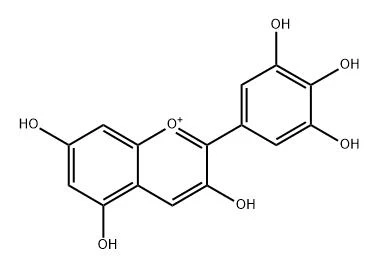
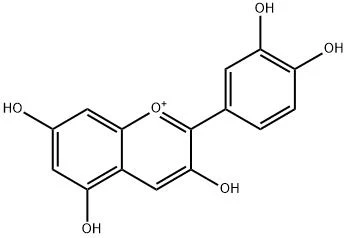
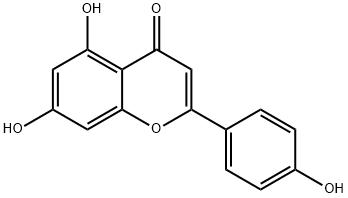
Cyanidin is a prominent natural organic compound belonging to the class of flavonoids, specifically categorized under anthocyanidins. It serves as the aglycone (sugar-free) precursor to numerous anthocyanins—the water-soluble pigments responsible for the vibrant red, purple, and blue hues found throughout the plant kingdom. Cyanidin is a polyhydroxy derivative of the flavylium cation. The presence of multiple phenolic hydroxyl groups dictates both its potent chemical reactivity and its specific optical characteristics.
Cyanidin possesses a highly conjugated system that shifts dynamically depending on the pH of its environment. This structural transformation changes its light absorption capabilities, functioning as a natural pH indicator:
pH < 3 : Flavylium cation (highly stable) Red
pH 7–8 : Neutral anhydrobase / Quinonoid form Violet / Purple
pH > 11: Chalcone / Ionized anhydrobase Blue
Cyanidin is highly susceptible to degradation when exposed to prolonged UV light, elevated temperatures, oxygen, and certain metallic ions (Fe3+, Al3+), which can trigger complexation or autoxidation.
Natural Occurrences and Biosynthesis
Natural Distribution
Cyanidin is found heavily concentrated within the skins, seeds, and tissues of dark fruits, berries, and specific vegetables, including:
Berries: Black raspberries, elderberries, chokeberries, bilberries, and cranberries.
Fruits: Red-skinned apples, plums, and red grapes.
Vegetables: Red cabbage and red onions.
Biosynthetic Pathway
In plant systems, cyanidin is synthesized via the shikimate pathway extending into the phenylpropanoid and polyketide paths:
Precursor Formation: L-phenylalanine undergoes deamination via phenylalanine ammonia-lyase (PAL) to yield cinnamate.
Chalcone Intermediate: Condensation of 4-coumaroyl-CoA with three molecules of malonyl-CoA by chalcone synthase yields naringenin chalcone.
Core Flavonoid Generation: Subsequent cyclization and enzymatic hydroxylation convert the chalcone into dihydrokaempferol and naringenin.
Final Oxidation: Anthocyanidin synthase (ANS) catalyzes the final oxidation and dehydration steps to yield the distinct flavylium core of cyanidin.
Industrial and Commercial Applications
Due to its inherent instability in its pure aglycone state, raw cyanidin (CAS No. 13306-05-3) is primarily commercialized as a high-purity analytical standard or specialized reagent. However, its derivatives maintain substantial industrial presence.
Nutraceuticals and Pharmaceuticals
Cyanidin acts as a potent radical scavenger and enzyme inhibitor. It demonstrates structural efficacy in mitigating lipid peroxidation, neutralizing superoxide (O2bullet) and DPPH radicals, and protecting DNA from oxidative cleavage.
Enzyme Inhibition: It displays targeted anti-inflammatory pathways, exhibiting micro-molar level inhibition (IC50) against prostaglandin endoperoxide synthases (PGHS-1 and PGHS-2).
Sirtuin Activation: It functions as a potent sirtuin 6 (SIRT6) activator, drawing research interest for metabolic syndrome and anti-aging therapeutic design.
Food and Beverage Industry (E163)
Under the European food additive classification E163, anthocyanin-rich extracts containing cyanidin derivatives are heavily utilized as natural colorants. They serve as clean-label replacements for synthetic dyes in acidic matrices such as juices, confectioneries, yogurts, and syrups, where the pH remains low enough to maintain a stable red hue.
Novel Technological Applications
Smart Packaging: Capitalizing on its precise color transformations across the pH spectrum, cyanidin is actively researched in polymer-film matrices to construct visual freshness indicators for perishable food packaging.
Dye-Sensitized Solar Cells (DSSCs): The hydroxyl networks on the cyanidin molecule allow it to effectively chelate with TiO2 nanoparticles, functioning as an eco-friendly, non-toxic organic photosensitizer for solar energy capture.
Handling, Solubility, and Laboratory Storage
Cyanidin is poorly soluble in pure water or standard neutral aqueous buffers. For laboratory configurations:
Organic Solvents: It displays optimal solubility in dimethyl sulfoxide (DMSO) and dimethylformamide (DMF).
Aqueous Stock Solutions: It should first be dissolved in a miscible organic solvent (like DMF) before being diluted into an aqueous buffer. Prepared aqueous solutions are highly unstable and must be utilized within 24 hours.
Storage Parameters
The compound should be preserved as a crystalline solid stored at -20℃ or lower, shielded entirely from moisture and light exposure. Desiccation under an inert gas blanket (such as Nitrogen or Argon) prevents premature oxidative degradation over extended storage periods.
Product:Cyanidin,CAS No.13306-05-3,Chalcone Intermediate,Core Flavonoid Generation, flavonoids