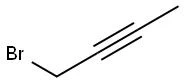
1-Bromo-2-butyne is an organobromine compound possessing a dense array of reactive functionality. Featuring both a terminal alkyl halide group and an internal carbon-carbon triple bond, it is widely classified as a specialized, high-value building block in modern synthetic organic chemistry, coordination chemistry, and pharmaceutical design.
Chemical Identity and Physico-Chemical Properties
1-Bromo-2-butyne is an unsymmetrically substituted alkyne. Its reactivity profile is driven by the structural juxtaposition of the highly polarizable carbon-bromine (C–Br) bond next to a rigid, electron-rich alkyne core.
Chemical Name: 1-Bromo-2-butyne
CAS Registry Number: 3355-28-0
Molecular Formula: C4H5Br
Molecular Weight: 132.99 g/mol
Physical and Structural Characteristics
- Appearance: Typically a clear, colorless to pale yellow or straw-yellow liquid at room temperature
- Boiling Point: Approximately 110°C to 112°C at atmospheric pressure.
- Density: Highly dense relative to water, typically ranging between 1.50 and 1.52 g/cm³ at 25°C.
- Solubility: Poorly soluble in water; highly miscible with non-polar and polar aprotic organic solvents, including dichloromethane (DCM), diethyl ether, tetrahydrofuran (THF), and pentane.
Chemical Reactivity and Synthetic Roles
The industrial utility of 1-bromo-2-butyne stems directly from its structural properties as a propargyl electrophile. It participates readily in a wide array of transformations.
Nucleophilic Substitution (SN2Reactions)
The primary application of 1-bromo-2-butyne is as an alkylating agent. The presence of the adjacent alkyne stabilizes the developing transition state during nucleophilic attacks, making the bromine atom an exceptionally viable leaving group.
- Amine Alkylation: It reacts with primary or secondary amines to form substituted N-(but-2-yn-1-yl)amines, providing clean access to propargylated linear amines or complex nitrogenous heterocycles.
- Enolate and Carbanion Alkylation: Strong nucleophiles, such as malonates or lithium enolates, easily displace the bromide ion to establish critical carbon-carbon (C–C) bonds.
Organometallic Reagent Generation
1-Bromo-2-butyne can be transformed into nucleophilic organometallic species. When reacted with elemental metals, it exhibits unique regioselective tendencies:
- Grignard Reactions: Treatment with magnesium generates a 2-butynylmagnesium bromide reagent. This species exists in a fluxional equilibrium with its allenic isomer, buttressing complex total synthesis pathways.
- Organoindium Mediated Additions: When reacted with indium metal, 1-bromo-2-butyne cleanly produces organoindium intermediates. These intermediates selectively cross-couple with complex aldehydes or ketones to yield allenols with remarkably high precision and yields, bypassing common side reactions like alkynol formation
Industrial and Research Applications
Because of its specific molecular architecture, 1-bromo-2-butyne is rarely consumed as an end product; instead, it is utilized as an intermediate in specialized industrial domains.
Asymmetric Synthesis and Chiral Ligand Construction
The compound is utilized in academic and industrial fine-chemical research to construct tailored molecular frameworks and complex natural products. The introduction of the rigid butyne moiety helps restrict conformational flexibility, making it a valuable tool in:
- Constructing novel chiral auxiliaries and stereocenters.
- Modifying oxazoline-containing and related asymmetric catalyst ligands designed for highly selective enantioselective transformations.
Pharmaceutical and Agrochemical Synthesis
In medicinal chemistry pipelines, introducing an alkyne group into a bioactive scaffold is a proven strategy for manipulating metabolic stability, lipophilicity, and binding affinity. 1-Bromo-2-butyne is employed to tether the 2-butyne functional group onto pharmaceutical intermediates, enabling subsequent transformations such as transitions into complex heterocyclic rings or structural motifs crucial for small-molecule drugs.
Handling, Safety, and Storage Protocols
As an active alkylating agent, 1-bromo-2-butyne presents a severe hazard profile that requires strict engineering controls and personal protective equipment (PPE).
Hazard Classifications
- Flammability: Flammable liquid and vapor. Keep away from open flames, sparks, and hot surfaces.
- Corrosivity and Irritation: Acts as a potent lachrymator. It causes severe skin burns, eye irritation, and upper respiratory tract irritation upon contact or inhalation.
- Toxicity: Harmful if swallowed, inhaled, or absorbed through the skin.
Handling & Storage Measures
- Engineering Controls: Operations should be performed strictly inside a certified chemical fume hood. Thorough ambient ventilation is mandatory.
- Personal Protective Equipment: Nitrile or Viton gloves, splash-proof chemical safety goggles, and full laboratory coats are required.
- Storage Conditions: 1-Bromo-2-butyne can degrade over time via light-induced radical pathway oxidation or polymerization. It must be stored under an inert atmosphere (nitrogen or argon), shielded from light, and kept refrigerated (typically at 2°C to 8°C) to maximize long-term shelf stability.
Product:3355-28-0,1-Bromo-2-butyne