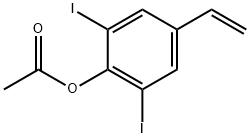
Chemical Overview
- Name: 2,6-Diiodo-4-vinylphenyl acetate
- CAS Number: 2600372-33-4
- Molecular Formula: C10H9I2O2
- Molecular Weight: 379.0 g/mol
- Appearance: Typically a solid, may be crystalline or powder, depending on the synthesis batch.
- Functional Groups: Contains a vinyl group (–CH=CH2) and an acetate ester (–OCOCH3) attached to a diiodinated phenyl ring.
Chemical Properties
2,6-Diiodo-4-vinylphenyl acetate is characterized by:
- Reactivity:
- The vinyl group allows for participation in polymerization reactions, such as free-radical polymerization.
- The diiodo-substituted aromatic ring can undergo halogen-exchange or cross-coupling reactions (e.g., Suzuki, Sonogashira) in synthetic chemistry.
- Stability:
- Relatively stable under ambient conditions but should be stored away from strong oxidizers or excessive heat to prevent decomposition.
- Solubility:
- Soluble in organic solvents such as dichloromethane, tetrahydrofuran (THF), and acetone; generally insoluble in water.
Applications
- Semiconductor Industry
- This compound serves as a monomer or precursor in the formulation of advanced photoresist materials.
- The vinyl group enables incorporation into polymeric matrices that are essential for high-resolution lithography processes.
- The iodine atoms can contribute to enhanced sensitivity to deep ultraviolet (DUV) or extreme ultraviolet (EUV) light, making it valuable in next-generation semiconductor patterning.
- Photoresist Industry
- As a functionalized aromatic acetate, it can be used in photoacid generator (PAG) systems or as a reactive monomer for chemically amplified resists.
- The combination of a vinyl group and halogen substitution allows for controlled cross-linking and polymerization, critical for achieving precise feature definition on silicon wafers.
- Electronic Chemicals
- Its chemical structure allows integration into high-performance polymeric coatings for electronics, improving etch resistance and pattern fidelity.
- It is used in research and development for novel resist materials and fine-tuning optical properties of lithographic polymers.
Handling and Safety
- Like many halogenated aromatic compounds, it should be handled with gloves and eye protection.
- Avoid inhalation and prolonged skin contact. Work in well-ventilated areas or fume hoods.
- Store in tightly sealed containers at controlled temperature, away from light and moisture to maintain chemical integrity.
Summary
2,6-Diiodo-4-vinylphenyl acetate is a specialized chemical intermediate primarily utilized in the semiconductor and photoresist industries. Its unique combination of a vinyl functional group and diiodo-substituted phenyl ring makes it valuable for polymerizable photoresist formulations, enhancing lithographic resolution and sensitivity for next-generation electronic devices. Proper handling and storage ensure stability and consistent performance in industrial applications.
Product:2600372-33-4, Semiconductor Photoresist, Electronic Chemicals